If you have actually ever before stood in front of a team of grown-up learners and assumed, I recognize they can do the work, however exactly how do I show it relatively and defensibly, you currently understand the heart of analysis layout. In the Australian veterinarian market, our commitments are clear, and so are the expectations from sector and learners. The virtuosity remains in transforming a system of proficiency right into a series of purposeful jobs that produce evidence, hold up under audit, and feel like actual job rather than busywork. That is the craft we develop in trainer and assessor courses, particularly with the TAE40122 Certificate IV in Training and Assessment.
Over the previous years, I have actually supported brand-new assessors as they built their very first tools, endured audits where one unclear verb unwinded an entire package, and saw strong prospects stumble because the task did not mirror the office. The good news is that strong style behaviors stop most headaches. What adheres to are field-tested suggestions attracted from experience and aligned to the criteria that underpin the cert IV training and assessment journey.
What a good analysis looks like
When you encounter a well made evaluation, it is obvious. The job reads like an office quick. Instructions appear and specific. Pupils recognize what to do, just how to provide it, and what great looks like. Assessors understand precisely what proof to collect and exactly how to evaluate it. Mapping is clear. If a prospect challenges an outcome, the records and benchmarked decisions reveal why.
Four words sit behind that self-confidence, the concepts of analysis: validity, integrity, fairness, and adaptability. Match them with the policies of evidence: legitimacy, sufficiency, credibility, and money. Good devices make these concepts and rules visible. As an example, a multi part task that mirrors an actual process goes after legitimacy and adequacy, a monitoring guide with clear behavioral pens sustains reliability and authenticity checks, and choices to use work environment documents or substitute design templates assist with justness and flexibility.
Start with the system, stay with the learner
TAE programs drum this in early. Start with the device of expertise, not with a pre enjoyed job. Rive the elements and performance requirements. Look very closely at efficiency proof, understanding evidence, and assessment problems. Then lay that against two truths, the student accomplice and the shipment context.
If you show a varied consumption in a certificate IV course, with trainees spread out throughout local business and larger organisations, it pays to develop tasks that can bend with context. As an example, a danger evaluation task might permit candidates to use their very own office plans if readily available, or a reasonable substitute collection otherwise. The evaluation stays the exact same in intent and judgement, yet the inputs can be adapted without bending standards.
Design tasks that mirror genuine work
Adults scent imagine. If the task inquires to re type a plan passage to reveal understanding, the eye roll will certainly be visible. If the task asks to encourage a brand-new starter making use of that policy and to document the conversation, they lean in. For most employment devices, the job occurs across a cycle, strategy, do, inspect, review. Style evaluations that adhere to the cycle rather than splintered mini jobs. All natural assessment minimizes duplication and better represents competence.
Take a system on customer care. Instead of 3 separate tasks for communication techniques, complaint handling, and record maintaining, develop a circumstance where the candidate fields a client inquiry, manages a rising problem, uses a CRM entry form, and prepares a follow up email. After that, layer in understanding checks about policy and lawful needs. One circumstance, several evidence strands.
In several cert iv trainer and assessor courses, we train this method for TAE40122 devices too. When assessing delivery, an observation of a session can gather evidence for preparation, resource use, communication, questioning, and examination. That is not catch reducing; it is exactly how the job really happens.
Evidence types worth their weight
Evidence comes in many forms. Direct observation, product assessment, questioning, 3rd party records, portfolios, and structured simulations are all sensible. The trick is to match evidence kinds to the verbs and context in the unit. If the system requires showing use of tools in a live atmosphere, written solutions alone will certainly never ever suffice. If the device requires expertise of regulation, a scenario based brief solution activity may be the cleanest check.
I like to intend evidence utilizing 3 columns. What must be shown, what is the most effective source of proof, and what high quality checks are required. For example, an office report can be current and authentic if it reveals metadata and a manager recommendation, yet it could not be sufficient unless it covers the full range of performance explained in the device. On the other hand, a simulated job can strike the variety because you can engineer it, however credibility needs to be thoroughly managed.
Third party proof is useful, yet never allow it lug the whole load. It should affirm, not change, what you as the assessor have observed or judged via other means.
Write directions like a good brief, not a riddle
Clarity beats brains. Pupils need to not decipher the job. Use energetic verbs. Specify deliverables. State data layouts or discussion needs where appropriate. Stay clear of elastic words like sufficient or enough without supports. If you desire a candidate to provide a session plan, name the design template or its called for sections, such as session end results, timing, resources, analysis checkpoints, and contingency planning.
Timeframes and attempt policies need to be specific. If reassessment is readily available, exactly how and when? If cooperation is enabled planning however except final entry, claim so. A lot of avoidable transgression comes from hazy borders as opposed to intent to deceive.
For assessors, companion directions matter just as much. Include assessor notes that explain the intent of each task, just how to probe with supplemental inquiries, and where judgement is expected versus where it is not negotiable.
Assessment conditions are not footnotes
The evaluation problems of a system are usually where audits start. If the system needs accessibility to details tools, a certain atmosphere, or straight observation by the assessor, the tool should demonstrate how those conditions will be met. Do not hide this on page 14. Surface the conditions at the front of the device, listing the called for sources, and state any kind of limited conditions such as time limits or supervision.
For simulation, document exactly how the workplace context is duplicated with enough realism. That could consist of the kinds of customers, the digital systems in operation, the complexity of jobs, and normal restraints like noise, interruptions, or security regulations. Strong simulation notes save you when a prospect finishes the analysis off website or through a partner location.
Reasonable change without reducing the bar
Fairness is not about making evaluations simple. It is about eliminating unneeded obstacles while preserving the rigour of the expertise. Practical adjustments usually include just how proof is gathered or offered, not what is shown. A candidate with dyslexia might give a verbal reflection tape-recorded through an assessor application instead of a lengthy written reaction. A prospect with limited key-board abilities might complete the exact same data entry task on a touch interface that mirrors workplace practice.
The secret is to document the adjustment, connect it to the student's demands, and document that the expertise results and the evidence rules remain undamaged. Change is not exemption. Trainer and assessor courses in the certificate 4 training and assessment collection present functional examples of this, from reformatting themes to scheduling split https://rylandqvs477.huicopper.com/top-study-tips-to-do-well-in-your-cert-4-in-training-and-assessment observations to handle fatigue.
LLN and assessment readability
Language, proficiency, and numeracy underpin performance. The most convenient method to thwart justness is to create evaluations at a reading degree two qualities above your students. For a cert iv cohort, go for plain English with technological terms discussed the first time they appear. Change nominalisations with verbs. Prefer short sentences. Usage white area and headings, not dense blocks of message. Where numbers matter, offer context, not just figures.
In one group of pupil electrical contractors, completion prices jumped 18 percent after we reworded guidelines right into everyday speech and added a one web page worked instance. The tasks did not alter. Words did.
Rubrics and marking guides that in fact guide
If two assessors mark the very same piece of job and arrive at different end results, you have a dependability trouble. A practical rubric narrows analysis. It spells out observable indicators for skilled efficiency. In veterinarian, we do not quality A to E, yet rubrics still assist by defining what qualified appear like for every criterion, together with common challenges to enjoy for.
I build marking guides with three components: the standard statement mapped to the unit, the proficient indicators, and assessor triggers. For a monitoring of a training session, the punctual might claim, Look for targeted inquiries that examine understanding and punctual much deeper reasoning, not simply recall. For a product testimonial, the punctual might say, Make sure the strategy consists of contingency approaches for at least two direct disruptions.
This level of detail supports small amounts later on and lowers assessor drift over time.
Mapping is your friend, not simply your auditor's
Unit mapping feels governmental up until you are trying to deal with a gap under pressure. Map every task, question, and evident actions to the pertinent aspect, performance requirement, knowledge evidence, and performance proof. Construct the matrix while you design, not after. When you locate a performance standard that is not plainly evidenced, make a small expansion or change the task to cover it. Avoid mapping a single concern to twenty requirements unless that concern genuinely generates that breadth of evidence.
For TAE40122 clusters, where several devices might be evaluated holistically, mapping is the safety net. In a collection that covers planning, distribution, and analysis layout, I map once with layers that show which job contributes to which system. That makes storage space and retrieval far less complicated when an auditor asks, Show me where you cover affordable change in assessment.
Pilot prior to you scale
No analysis tool makes it through first call with an actual cohort the same. Pilot it with a handful of learners or associates. Time the jobs. Ask trainees to believe aloud as they read instructions, keeping in mind any kind of stumbling factors. Debrief with assessors after first usage. In one trainer and assessor course, a presentation task constantly ran 20 minutes over the planned home window. The repair was not to reduce content but to supply a time stamped run sheet and a pre ready resource pack to lower configuration delays.
Bear in mind that a pilot is not almost period. It examines alignment to the system, the adequacy of resources, the realistic look of circumstances, and the functionality of templates.
Feedback that educates, documents that protect
Assessment gives a verdict and a finding out minute. Written feedback needs to be specific and linked to requirements. It ought to cite evidence from the prospect's work. A remark like Excellent work is courteous yet vacant. Better to compose, Your session strategy sequenced tasks with dynamic difficulty and consisted of backup for devices failure, which fulfills the preparation criteria.
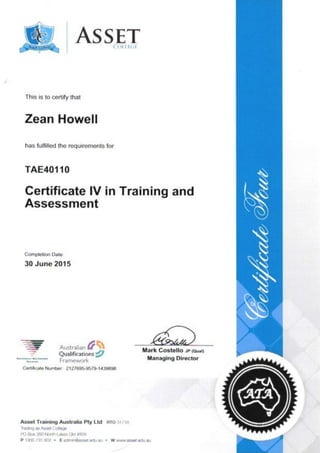
At the same time, your documents must make your decision clear to a third party. Helpful hints That means recording the variation of the tool utilized, any changes used, the day and context of observation, the assessor who made the phone call, and the proof gathered. Digital platforms assist, but also a self-displined paper trail works if maintained.
Workplace evidence, simulated tasks, and the pleasant spot
Not every learner has similar workplace access. Some have abundant atmospheres, others discover via substitute contexts. A thoughtful instructor balances both. For instance, in a certificate iv training and assessment context, delivery observations can take place in an online work environment training session or in a substitute class with peer learners. The expertise is the same, however the variables vary. If you make use of simulation, raise bench on complexity and realism for the lack of office pressure.
Where possible, mix proof. Use a simulated circumstance for controlled assessment of should see actions, then accept workplace logs or artefacts that reveal continuity and transfer over time. This hybrid approach often produces stronger sufficiency than either technique alone.
RPL is evaluation, not a shortcut
Recognition of Prior Discovering ought to sit on the exact same rails as conventional evaluation. The distinction depends on proof collection, not standards. Premium quality RPL kits lead prospects to existing curated proof mapped to the device, such as work samples, supervisor testimonies, training documents, and reflective statements. Assessors then validate credibility, test knowledge spaces via targeted examining, and, where needed, timetable practical demonstrations.
In the cert 4 in training and assessment space, I as soon as evaluated an experienced office instructor that had delivered onboarding for years. Their profile was impressive, but gaps arised around recognition procedures and documents standards anchored to RTO practice. A brief obstacle task and a meeting shut those gaps. The final outcome was durable and defensible.
Validation and small amounts maintain you honest
Two high quality procedures tend to obscure in individuals's minds. Small amounts is about assessor arrangement on reasonings for a particular assessment, typically before or soon after noting. Recognition is a more comprehensive review of assessment devices, processes, and results, typically carried out article evaluation, to verify they are fit for objective and generate legitimate results.
Schedule them. Paper them. Revolve assessors via each various other's devices. Use samples that span proficient and not yet competent results. Keep your validation actions visible with owners and timeframes. Many RTOs activate recognition after a new device has run twice and once more at established intervals. That rhythm maintains drift in check.
The usual challenges and just how to evade them
Most troubles repeat. An unit's evaluation problems discuss particular tools, yet the device ignores it. A job relies just on written responses to assess a skill that should be shown. Mapping claims coverage that the tool does not produce in technique. Directions indicate open book yet the evaluation is carried out as closed book. Sector context in the circumstance is generic and as a result irrelevant to half the cohort.
The fix is not brave effort, it is regular persistance. Review the unit gradually. Write simple English tasks. Develop mapping early. Evaluate the tool with an associate who was not associated with creating it. Readjust with humility.
A fast pre launch checklist
- Read the device again, focusing on performance proof and assessment problems. Mark any type of non negotiables that should show up in the tool. Confirm each job produces valid, sufficient, authentic, and present proof. If one policy is weak, include or change the evidence source. Tighten guidelines for learners and assessors. Include a worked instance or model feedback if it aids clarity. Build or improve the marking guide so 2 assessors would likely land on the same choice using it. Pilot with at least 3 prospects or peers, collect information on timing and confusion points, and fix the top issues before complete rollout.
A straightforward process that functions throughout contexts
- Analyse the unit and learner mate, paper constraints and chances such as workplace gain access to or LLN needs. Design alternative tasks that mirror genuine workflows, choose proof kinds per requirement, and illustration mapping alongside. Draft learner directions and assessor guides with each other, then build marking guides and observation devices with concrete indicators. Assemble sources and simulation notes, verify assessment conditions, and strategy practical modification pathways. Pilot, gather comments, confirm with a peer, settle versions, and timetable small amounts after first marking.
Where the cert IV comes in
People commonly ask what the Certificate IV in Training and Assessment truly transforms in an expert. Past compliance, it transforms how you think. In the cert iv tae devices that cover analysis style, you learn to see surprise assumptions, to interrogate verbs in efficiency requirements, and to construct tools that offer learners and market. The TAE40122 upgrade strengthened that shift by tightening links in between analysis and industry money, by stressing recognition methods, and by refining assumptions for practical simulation.
If you are considering a trainer and assessor course, try to find distribution that treats you like the expert you are. Seek programs where you design and test devices, not simply read about them. Proof the job you will do at work. Whether individuals call it cert 4 training and assessment, certificate iv training and assessment, or simply the TAE course, the goal is the same, construct positive experts who develop and judge capability with integrity.
Final ideas from the coalface
Strong evaluation layout rests at the crossway of requirements, market reality, and human discovering. It takes perseverance to map entirely, nerve to cut pet jobs that do not include proof, and technique to keep documents as clean as your intents. Yet the payoff is substantial. Learners trust the procedure. Companies rely on the result. Auditors nod rather than frown. And you, as an assessor, rest far better understanding your decisions are sound.
If you are honing these abilities via a certificate 4 in training and assessment or currently hold a certificate iv and intend to freshen for TAE40122, keep repeating. Review old tools with brand-new eyes. Swap sets with an associate and review with generosity. Attempt one brand-new simulation detail each term to edge closer to realistic look. And when a candidate surprises you with a better method to proof a requirement within the policies, include that choice for the next friend. That routine, more than any list, keeps your assessments active, reasonable, and defensible.